⚡ Key Takeaways
- ✅ The best bulk meat strategy begins with knowing your freezer space, cooking habits, and realistic household demand.
- ✅ Buying whole, half, or quarter animals can save money, but only if you understand yield, cuts, and storage costs.
- ✅ Price per pound is useful, but price per usable meal is the smarter number.
- ✅ A chest freezer, vacuum sealing, and clear labeling turn bulk buying from chaos into a quiet domestic triumph.
- ✅ Local farms, warehouse clubs, butchers, and meat shares each suit different budgets and priorities.
- ✅ The best deals often include less glamorous cuts, which reward patient cooks with excellent meals.
- ✅ Bulk meat buying is most successful when paired with meal planning, inventory tracking, and a refusal to let freezer mystery packages multiply.
Buying meat in bulk sounds, at first, like the sort of project that belongs to people with spreadsheets, garage freezers, and strong opinions about brisket. Yet it is also one of the more practical ways ordinary households can save money, eat better, and reduce the weekly grocery-store shuffle. Done well, bulk meat buying is not a hoarder’s sport. It is closer to building a small pantry of possibility: roasts for Sundays, ground beef for Tuesdays, chicken thighs for emergencies, bones for broth, and pork shoulder for the day you remember your slow cooker has been patiently waiting for its moment. 🥩
The trouble is that meat is expensive, perishable, and emotionally charged in a way lentils rarely are. Nobody wants to spend hundreds of dollars only to discover that half the freezer is filled with cuts they do not know how to cook. The best strategy, then, is not simply “buy more because it is cheaper.” The best strategy is to buy the right amount, from the right source, in the right cuts, with a plan for using every pound.
In other words, bulk meat buying rewards the prepared and mildly punishes the impulsive. Fortunately, preparation is not difficult. It just requires a freezer, a pencil, a bit of arithmetic, and the humility to admit that your family may not, in fact, eat liver every Thursday no matter how noble your intentions.
Start With the Freezer, Not the Farm 🧊
The romantic version of bulk buying begins with a handshake at a farm gate and ends with a freezer full of neatly wrapped steaks. The practical version begins with measuring your freezer. This is less picturesque but far more important.
A standard refrigerator freezer can usually hold only a modest bulk purchase: perhaps 20 to 40 pounds of meat, depending on how many bags of peas and half-finished ice cream cartons already occupy the territory. A small chest freezer may hold 100 to 150 pounds. A larger chest or upright freezer can handle a quarter beef, half hog, or several months’ worth of mixed cuts.
As a rough guide, one cubic foot of freezer space holds about 30 to 35 pounds of packaged meat. That figure is not biblical truth, but it is a useful planning number. A quarter beef might yield 100 to 130 pounds of packaged meat. A half hog might yield 70 to 100 pounds. A bulk chicken order could be anywhere from 20 to 80 pounds. The freezer, therefore, is not an accessory to the strategy. It is the strategy’s border control.
The first law of bulk meat buying is simple: a bargain is not a bargain if it has nowhere safe to sleep.
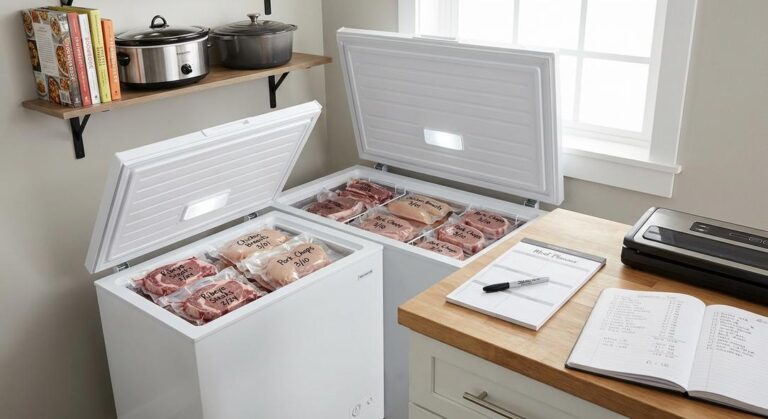
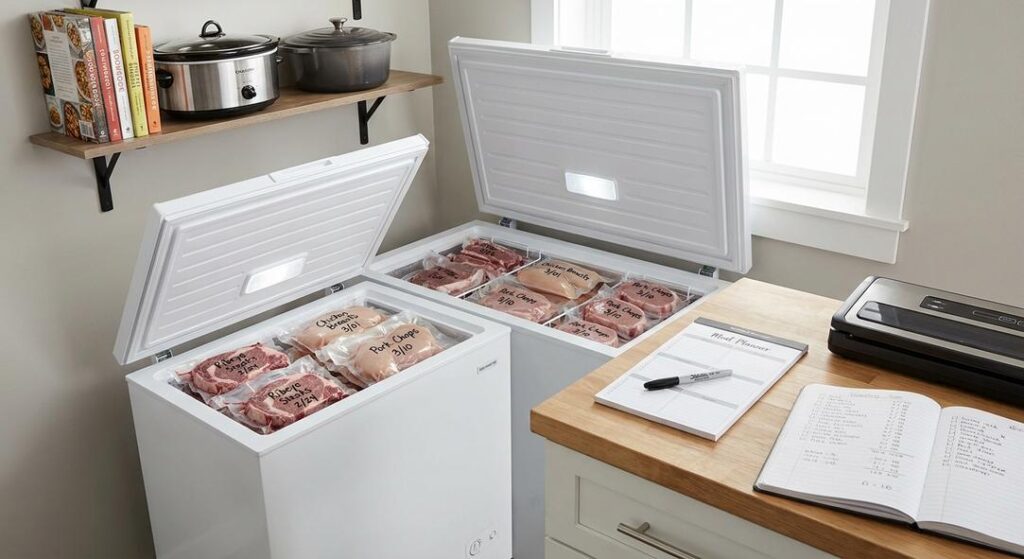
Before buying, take inventory. Remove old packages, identify what is actually usable, and make room. If you are serious about buying in bulk, a chest freezer is often worth the investment. It uses relatively little electricity, holds temperature well, and can pay for itself over time. Just remember that a freezer is not a black hole; it is a storage system. Without organization, it becomes a cold museum of forgotten ambitions.
Know What Your Household Actually Eats 🍽️
This is where fantasy and dinner part ways. Many people imagine that bulk buying will make them more virtuous cooks. They picture themselves braising shanks, simmering stock, and lovingly preparing obscure cuts. Sometimes this happens. Often, the family still wants tacos.
The best strategy is to examine your real eating patterns before you order. How often do you cook meat? Which proteins do you use most? Are you a household of chicken breast loyalists, ground beef pragmatists, steak celebrants, or pork chop regulars? Do you grill? Do you own a slow cooker, smoker, pressure cooker, or Dutch oven? More importantly, do you use it?
For a small household, 100 pounds of beef may be a year-long commitment. For a family of five, it may be three months of ordinary dinners. There is no universal right amount. There is only the right amount for your kitchen.
A useful exercise is to estimate weekly use:
- How many meat-based dinners do you cook per week?
- How many pounds do you use per meal?
- Do you pack leftovers for lunches?
- Do you entertain often or cook mostly for yourself?
- Would you rather buy six months of one protein or two months of variety?
If you cook four meat-based dinners weekly and use about 1.5 pounds per meal, that is roughly 6 pounds a week, or 300 pounds a year. That number may sound startling until you remember how quietly groceries accumulate. A bulk order simply makes the pattern visible.
Do not ignore preferences. If nobody in the house enjoys pork loin, a freezer full of it is not thrift; it is a hostage situation. Buy for the table you have, not the imaginary farmhouse table of your culinary dreams. 😊
Understand the True Price: Hanging Weight, Packaged Weight, and Meal Value 💰
Bulk meat pricing can be confusing because sellers may use different numbers. You may see prices based on live weight, hanging weight, or packaged weight. These are not interchangeable, and misunderstanding them is how bargain hunters become grumpy philosophers.
Live weight is the animal’s weight before processing. Hanging weight is the carcass weight after slaughter but before cutting, trimming, and deboning. Packaged weight is what you actually bring home and put in the freezer. Packaged weight is always lower than hanging weight because bone, fat, moisture loss, and trim are removed during processing.
For example, if a quarter beef is sold at a price per pound of hanging weight, the final cost per pound of packaged meat will be higher. This is not dishonest; it is simply how the industry works. But you need to calculate the real cost.
Here is the better way to think about value:
- Ask for the estimated hanging weight.
- Ask for the estimated packaged yield.
- Include processing, cutting, wrapping, delivery, and freezer costs.
- Divide the total cost by the packaged pounds you will receive.
- Then consider how many meals those pounds will produce.
The last step matters. A $7-per-pound average for a beef share may sound high if you compare it to discount ground beef. But if the order includes steaks, roasts, ribs, stew meat, ground beef, and bones, the comparison changes. Conversely, a cheap box of random frozen meat may not be a deal if your family eats only half of it willingly and the rest becomes freezer sediment.
Price per pound gets your attention; price per enjoyable meal tells the truth.
The smartest buyers compare bulk purchases not just with grocery-store sale prices but with their own habits. If bulk meat keeps you from ordering takeout twice a month, the savings may be larger than the freezer label suggests.
Choose the Right Source: Farm, Butcher, Warehouse, or Meat Share 🚜
There are several ways to buy meat in bulk, and each has virtues and drawbacks. The “best” source depends on whether your priority is price, quality, convenience, animal welfare, local agriculture, or sheer predictability.
Local farms are often ideal for people who want transparency. You can ask how animals are raised, what they are fed, whether they are pastured, and how processing is handled. Buying a quarter cow, half hog, or lamb share from a farm can provide excellent quality and a direct relationship with the producer. The trade-off is that you usually have less control over getting only familiar cuts.
Independent butchers offer expertise and flexibility. A good butcher can help you choose cuts, portion sizes, and packaging styles. They may sell freezer bundles: 25, 50, or 100 pounds of assorted meats. These bundles are a friendly middle ground for beginners because they offer variety without requiring you to adopt an entire side of beef.
Warehouse clubs are convenient and often price-competitive. They are especially useful for bulk packs of chicken thighs, ground beef, pork shoulder, ribs, and steaks. The downside is that packaging may not be freezer-ready, so you must portion and wrap meat at home.
Online meat companies and subscription boxes offer convenience and specialty products, such as grass-fed beef, heritage pork, or wild seafood. They are rarely the cheapest option, but they can be consistent and useful for households that value delivery and curated cuts.
Community meat shares or buying clubs can be excellent if you have neighbors, relatives, or friends who want to split a larger order. This reduces freezer pressure and allows you to test bulk buying without turning your basement into a meat archive.
When choosing a supplier, ask direct questions:
- What is included in the order?
- Is the price based on hanging weight or packaged weight?
- Are processing fees included?
- How is the meat wrapped?
- Can I choose thickness, package size, or ground meat ratios?
- When will the meat be ready?
- How long has the supplier been working with the processor?
A reputable seller will welcome questions. If someone acts offended because you want to know what you are buying, that is not rustic charm. That is a warning sign.
Learn to Love the Whole Animal, Not Just the Celebrity Cuts 🍖
Bulk buying is most rewarding when you stop treating steaks and chicken breasts as the main event and begin appreciating the supporting cast. The economics of meat are unforgiving: everyone wants ribeyes, tenderloins, and boneless skinless breasts, but animals are not assembled entirely from premium cuts. If they were, cattle would look absurd.
Less fashionable cuts are often where the flavor lives. Chuck roast, short ribs, pork shoulder, lamb shanks, chicken thighs, oxtail, neck bones, and stew meat reward low, slow cooking. They are not inferior; they are simply less convenient. Time is the seasoning they require.
If you are buying a share of an animal, expect a range of cuts. That variety is part of the value, but only if you are prepared to use it. Learn a handful of flexible cooking methods and the freezer becomes less intimidating.
- Braising: ideal for chuck roast, short ribs, shanks, and shoulder cuts.
- Slow cooking: excellent for pulled pork, stew meat, and tougher roasts.
- Pressure cooking: useful when you want tenderness without waiting all afternoon.
- Grinding or mincing: helpful for trim, stew meat, or cuts destined for sauces and dumplings.
- Stock making: turns bones, wings, backs, and connective tissue into liquid gold.
The trick is to plan around categories rather than precise recipes. Keep a mental roster: quick-cook cuts, slow-cook cuts, ground meat, bones, and special-occasion pieces. Then your freezer is no longer a jumble of frozen rectangles. It is a library, and dinner is a matter of choosing the right volume. 📚
The unpopular cuts are not a burden. They are an invitation to cook with patience, which is usually where the best meals begin.
Package Like a Professional, Label Like a Librarian 🏷️
Good packaging is the difference between future dinner and future freezer burn. If you buy from a farm or butcher, ask whether the meat will be vacuum sealed, butcher wrapped, or packed in plastic. Vacuum sealing generally provides the longest freezer life, especially for long-term storage.
If you buy large packs from a warehouse store, repackage them before freezing. It is tempting to toss the entire tray into the freezer and call yourself efficient. Resist. Future you does not want to chisel apart eight chicken breasts at 6 p.m. on a Wednesday.
Portion meat according to how you cook. If your household uses one pound of ground beef for chili or pasta sauce, freeze it in one-pound packages. If two pork chops feed dinner, wrap them in pairs. If you marinate chicken thighs in batches of six, package them that way. Bulk buying works beautifully when the freezer reflects your actual recipes.
Label everything with three pieces of information:
- The cut or item
- The weight or portion size
- The date frozen
Add cooking notes if useful: “stew,” “tacos,” “grill,” “stock bones,” or “marinated.” The label need not be poetic. In fact, poetry is discouraged. Clarity is the goal. “Beef, maybe?” is not a label; it is a cry for help.
For home packaging, a vacuum sealer is worth considering if you buy often. Freezer paper and heavy-duty freezer bags also work when used carefully. Remove as much air as possible, wrap tightly, and avoid thin sandwich bags, which are better suited to crackers than six months of subzero endurance.
Keep an Inventory, or Prepare for Archaeology 📋
The freezer has a mischievous talent for hiding things. Without an inventory, you may buy ground beef while twelve pounds of it sit quietly beneath a bag of frozen blueberries. Inventory is not glamorous, but neither is throwing away meat because you forgot it existed.
Keep a simple list on the freezer door, in a notebook, or on your phone. Record what goes in and what comes out. You do not need restaurant-level precision. You need enough information to prevent duplication and encourage rotation.
A useful freezer inventory might include:
- Cut or item
- Number of packages
- Approximate weight
- Date frozen
- Priority use category, such as “use soon” or “special meal”
Practice first-in, first-out rotation. Older packages should be used before newer ones. This seems obvious until you realize that humans are naturally inclined to grab whatever is on top, which is how ancient pork chops achieve seniority.
Every month, do a quick freezer review. Build meals around what is already there. If you see too many roasts, plan a stew, shredded beef, or Sunday braise. If ground meat is running low, save it for meals where convenience matters. If bones are accumulating, make stock. Inventory turns bulk buying from passive storage into active meal planning.
Time Your Purchases and Watch for Seasonal Value ⏰
Meat prices move with seasons, supply, holidays, feed costs, fuel costs, and consumer demand. While you cannot control the market, you can buy with a bit of timing.
Turkeys are often cheapest around major holidays. Hams and roasts may be discounted after holiday peaks. Grilling cuts often rise in popularity during warmer months, while roasts and stew cuts may be more attractive in colder seasons. Farms may have set processing dates, especially for beef, pork, and lamb, so ordering ahead is often necessary.
Warehouse stores and supermarkets frequently offer bulk discounts on family packs, but the best deals are only useful if you can process them promptly. When chicken thighs go on sale, buy enough for a month or two, not so much that your freezer becomes a poultry annex.
For farm purchases, ask when animals are typically processed and whether deposits are required. Many small farms operate on reservation systems. If you wait until you are out of meat, you may find that the next available quarter beef is months away. Bulk buying favors those who think one season ahead.
The cheapest meat is often the meat you planned for before you urgently needed it.
Still, do not let a sale bully you. A discount is an invitation, not a command. If your freezer is full or your budget is tight, the finest strategy may be to walk away with dignity and perhaps a modest package of sausages.
Balance Ethics, Quality, and Budget Without Losing Your Mind 🌱
Meat buying is not only arithmetic. It touches questions of animal welfare, environmental impact, nutrition, labor, and local economies. Bulk buying can help consumers make more intentional choices because it encourages a relationship with the source rather than a last-minute grab from a fluorescent case.
For some households, grass-fed beef, pasture-raised poultry, heritage pork, or local processing are priorities. For others, affordability comes first. Most people live somewhere in the middle, trying to do the best they can within real constraints. There is no virtue in buying meat you cannot afford, and no wisdom in ignoring quality if you have the means to choose better.
The key is to define your priorities before shopping. Perhaps you care most about local farms. Perhaps you want antibiotic-free poultry. Perhaps you need the lowest possible cost per meal. Perhaps you want a mix: local beef once a year, warehouse chicken monthly, and sale-priced pork when available. That is not inconsistency; it is strategy.
Ask about production practices, but also ask about taste and usability. A beautifully raised animal still needs to become dinner. The most ethical purchase is one you will actually eat fully, respectfully, and without waste.
The Best Strategy: Start Small, Learn, Then Scale 🧠
If you are new to bulk meat buying, do not begin with a half cow unless you are confident, well-equipped, and surrounded by people who share your enthusiasm for pot roast. Start with a manageable experiment.
Buy a 25-pound butcher bundle. Split a quarter beef with a friend. Purchase a month’s worth of chicken thighs, ground beef, or pork shoulder on sale. Practice portioning, labeling, freezing, thawing, and meal planning. Notice what disappears quickly and what lingers. Your freezer will tell the truth if you listen.
A smart beginner plan might look like this:
- Clean and measure freezer space.
- Calculate your household’s monthly meat use.
- Choose one protein you already cook often.
- Buy a moderate bulk quantity from a reliable source.
- Portion and label everything immediately.
- Track how long it lasts and what meals you make.
- Adjust your next purchase based on evidence, not optimism.
Once you understand your rhythm, scaling up becomes easier. You may discover that a quarter beef every year suits you perfectly, or that smaller mixed bundles are better. You may decide that warehouse chicken plus a local pork share gives you the right balance of savings and quality. The goal is not to win a freezer-filling contest. The goal is to feed your household well.
The best bulk meat buyers are not necessarily the people with the biggest freezers. They are the people who waste the least, cook with the most flexibility, and understand the quiet power of having dinner already halfway solved.
A Sensible Freezer Is a Form of Freedom ✅
Buying meat in bulk is a small act of domestic foresight. It reduces the number of frantic grocery trips, softens the blow of price spikes, and encourages more deliberate cooking. It can connect you to local producers, improve the quality of your meals, and make weeknight dinner feel less like a negotiation with fate.
But the best strategy is disciplined, not dramatic. Know your space. Know your appetite. Know your cuts. Ask clear questions. Package carefully. Keep records. Cook the overlooked pieces. Respect the animal by wasting as little as possible. If you do those things, bulk meat buying becomes less about stockpiling and more about stewardship.
There is genuine pleasure in opening a well-organized freezer and seeing not clutter, but options. A roast for company. Ground meat for chili. Bones for broth. Chicken for tomorrow. Dinner, in its many future forms, waiting patiently in the cold.
FAQ
How much meat should I buy in bulk for the first time?
Start with one to two months of your normal meat consumption. For many households, that means 20 to 50 pounds, not an entire animal share. A smaller purchase lets you test your freezer space, packaging habits, and cooking patterns before committing more money.
Is buying a quarter cow really cheaper?
It can be, especially when compared with buying individual steaks, roasts, and ground beef at regular retail prices. However, you must calculate the total cost, including processing fees, and divide it by the packaged weight. It is cheapest when you use all the cuts, not just the premium ones.
What meat is best to buy in bulk?
The best meat to buy in bulk is the meat you already cook often. Ground beef, chicken thighs, pork shoulder, whole chickens, and versatile roasts are strong choices. Avoid bulk purchases of cuts your household rarely eats, no matter how attractive the price looks.
How long does meat last in the freezer?
Properly wrapped meat can remain safe indefinitely if kept continuously frozen, but quality declines over time. For best flavor, use ground meat within 3 to 4 months, steaks and chops within 6 to 12 months, and roasts within about a year. Vacuum sealing can extend quality significantly.
Do I need a vacuum sealer for bulk meat?
You do not absolutely need one, but it helps. Vacuum sealing reduces air exposure and freezer burn, making it especially useful for long-term storage. If you do not have one, use freezer paper, heavy-duty freezer bags, tight wrapping, and clear labels.