⚡ Key Takeaways
- ✅ The easiest water savings come from fixing leaks, upgrading fixtures, and adjusting habits you barely notice.
- ✅ Modern low-flow showerheads and faucet aerators can cut usage without making your home feel like a campsite.
- ✅ Dishwashers and washing machines often use less water than hand-washing or half-load laundering.
- ✅ Toilets, showers, and outdoor watering are usually the biggest opportunities for painless reductions.
- ✅ Smart irrigation, mulch, native plants, and watering at the right time can dramatically reduce garden demand.
- ✅ Small behavioral tweaks, like turning off taps while brushing teeth, add up because they happen daily.
- ✅ Reducing water use also saves energy, money, and strain on local water systems.
Most advice about saving water arrives dressed like a punishment. Shower faster. Let the lawn die. Stop enjoying baths, gardens, clean clothes, pasta, or happiness. No wonder people nod politely and continue exactly as before. 💧
But the more interesting truth is this: the average household wastes a surprising amount of water not because its residents are reckless, but because homes are full of tiny invisible inefficiencies. A toilet that sighs into the bowl all night. A showerhead installed during the Clinton administration. A sprinkler watering the sidewalk with the devotion of a monk. These are not lifestyle choices. They are plumbing gossip.
Reducing water usage at home does not have to mean becoming a person who times showers with a marine whistle. In fact, the best changes are the ones you stop noticing after a week. They live in fixtures, settings, maintenance, timing, and design. They protect your routines while quietly lowering your bill and your environmental footprint.
Water conservation is often framed as sacrifice, but in domestic life it is more often a matter of precision. Use the water you actually want. Stop paying for the water that escapes, evaporates, leaks, or swirls theatrically down the drain with no purpose whatsoever.
Start With the Water You Never Meant to Use 🔍
If you want to cut water use without changing your lifestyle, begin with leaks. They are the pickpockets of the household economy: small, quiet, and astonishingly effective. A dripping faucet can waste thousands of gallons a year. A running toilet can waste far more, often without the dramatic sound effects one might expect from such theft.
The simplest test is old-fashioned and wonderfully low-tech. Check your water meter, avoid using water for an hour or two, then check it again. If the number has moved, your house is using water without you. That is not conservation. That is a mystery novel with pipes.
Toilets deserve special suspicion. Add a few drops of food coloring to the tank and wait 10 to 15 minutes without flushing. If color appears in the bowl, the flapper or valve is leaking. Replacing a toilet flapper is inexpensive, quick, and does not require a personality transformation.
The most painless gallon saved is the gallon you were never using on purpose.
Look also under sinks, behind washing machines, around outdoor spigots, and at hose connections. A leak does not have to be cinematic to be costly. Sometimes it is merely damp drywall, mineral crust, or a suspicious patch of eternal green in the yard.
- Replace worn toilet flappers and fill valves.
- Tighten or repair dripping faucets.
- Inspect hose bibs and irrigation connections.
- Check appliance hoses for bulges, cracks, or moisture.
- Monitor your water bill for unexplained increases.
This is the least glamorous section of water conservation, but it is also the most satisfying. You fix something once, and the savings continue while you sleep.
Upgrade Fixtures, Not Your Personality 🚿
There was a time when “low-flow” meant standing under a showerhead that seemed to apologize for itself. Those days are largely over. Today’s efficient fixtures are much better engineered, mixing air and pressure to create a satisfying flow while using less water. You still get a proper shower. You simply stop hosting a private waterfall every morning.
Showerheads are a major opportunity because showers account for a significant share of indoor household water use. A standard older showerhead may use 2.5 gallons per minute or more. Efficient models often use closer to 1.5 or 2.0 gallons per minute, with little perceptible difference if you choose a good one.
Faucet aerators are even easier. They screw onto bathroom and kitchen taps and reduce flow while preserving pressure. They are inexpensive, nearly invisible, and among the rare home improvements that do not demand a Saturday, three trips to the hardware store, and a solemn apology to your spouse.
Toilets matter too. Older toilets can use 3.5 to 7 gallons per flush. Modern WaterSense-labeled toilets use far less, often around 1.28 gallons per flush, and dual-flush models allow different volumes for different needs. If replacing a toilet sounds too ambitious, even repairing its internal parts can deliver meaningful savings.
- Install WaterSense-labeled showerheads for strong performance with lower flow.
- Add faucet aerators in bathrooms and kitchens.
- Consider dual-flush or high-efficiency toilets during renovations.
- Choose fixtures from reputable brands with good pressure reviews.
- Keep old parts clean, since mineral buildup can distort flow and encourage waste.
The point is not to live less comfortably. The point is to stop confusing high volume with high quality. A well-designed fixture is like a good editor: it removes excess without making the result feel diminished.
Let Machines Do the Efficient Work 🍽️
Many people still believe hand-washing dishes is the virtuous option. It feels humble and sensible. Unfortunately, feelings are not always hydraulically accurate. A modern dishwasher, run full, often uses less water than washing the same load by hand, especially if the tap runs continuously.
The same logic applies to laundry. Washing machines vary widely, but newer high-efficiency models use dramatically less water than older top-loaders. Even without replacing your machine, you can reduce waste by using the correct load setting and avoiding tiny loads unless the machine has a reliable sensor.
The trick here is to let appliances work as designed. Scraping plates is usually enough; pre-rinsing under a running tap is often unnecessary with modern dishwashers. If something is truly fossilized onto a pan, soak it rather than blasting it with hot water for five minutes while contemplating your life choices.
Efficiency is not always about doing less. Sometimes it is about letting the right machine do the job better than your hands can.
There is also an energy connection. Hot water requires energy to heat, so using less of it reduces both your water and utility bills. This is especially true in laundry, where cold-water detergents have improved significantly. For many everyday loads, cold water is perfectly adequate and gentler on fabrics.
- Run dishwashers only when full, but not overpacked.
- Skip pre-rinsing unless your dishwasher truly requires it.
- Use eco modes when time is not urgent.
- Wash full laundry loads whenever possible.
- Use cold water for routine laundry.
None of this asks you to become less clean. It simply asks you to stop using a fire hose where a measured cycle will do.
Make the Bathroom Quietly Smarter 🛁
The bathroom is where much of domestic water use happens, and it is also where advice tends to get moralistic. But nobody needs another lecture about five-minute showers delivered in the tone of a disappointed gym teacher. Instead, look for changes that preserve the ritual while trimming the waste around it.
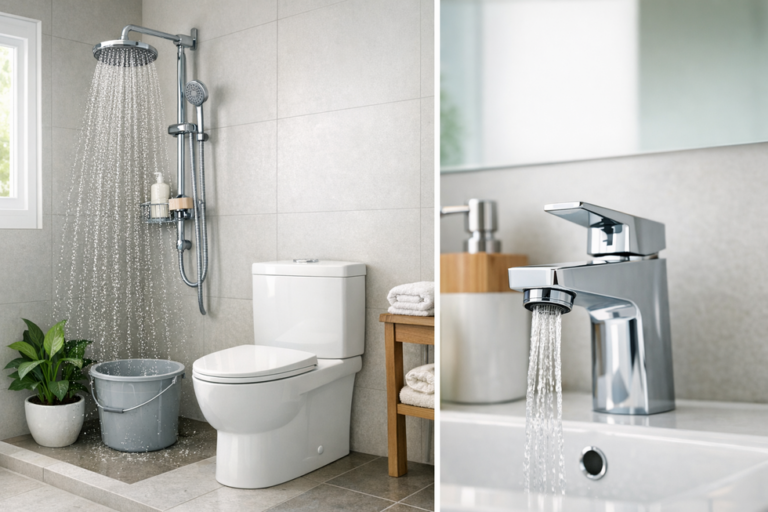
For example, a thermostatic shower valve or temperature memory setting can reduce the time spent running water while waiting for it to warm. If your shower takes ages to heat, consider collecting the initial cold water in a bucket and using it for plants. That is a small behavior change, yes, but it need not disturb the shower itself.
Turning off the tap while brushing teeth or shaving is one of those habits so small it feels almost silly to mention. Yet it works because it happens every day. A tap running for two minutes can waste several gallons. Multiply that by people, mornings, nights, and years, and suddenly the silly thing has become a reservoir.
Baths are not forbidden. A full bathtub can use more water than a short shower, but a long high-flow shower can easily surpass a modest bath. The sensible approach is not puritanical. Enjoy the bath when you want one. Just make the default systems efficient so occasional indulgence is not carrying the burden of everyday waste.
- Use an efficient showerhead that still feels satisfying.
- Fix slow toilet leaks promptly.
- Turn off taps during brushing, shaving, and face washing.
- Install a shower timer if you enjoy data more than nagging.
- Collect warm-up water for houseplants if practical.
The bathroom’s secret is repetition. Tiny adjustments here have unusual power because they are attached to rituals that happen every single day.
Rethink the Garden Without Declaring War on Greenery 🌿
Outdoor water use can dwarf indoor use, particularly in dry climates or during summer. The culprit is often not the existence of a garden, but the way it is watered. Sprinklers running at noon, overspray on pavement, shallow daily watering, and thirsty plants in the wrong place can turn a yard into a municipal-scale drinking habit.
The first rule is timing. Water early in the morning, when evaporation is lower and plants can absorb moisture before heat intensifies. Evening watering is sometimes acceptable, but in humid regions it can encourage fungal disease. Midday watering is mostly a gift to the atmosphere.
The second rule is depth. Many lawns and plants do better with deeper, less frequent watering than with daily sprinkles. Shallow watering encourages shallow roots, which then demand more watering. It is the botanical version of creating a dependent adult child.
Mulch is one of the great unsung heroes of water conservation. It reduces evaporation, moderates soil temperature, suppresses weeds, and makes garden beds look as though someone responsible lives there. A few inches of organic mulch around plants can significantly reduce irrigation demand.
A water-wise garden is not a barren garden. It is a garden designed for the climate it actually lives in.
If you are planting or renovating, choose native or climate-adapted plants. They are not merely fashionable; they are local professionals. Once established, many require less supplemental water and provide better support for pollinators and wildlife. Group plants with similar water needs together so you are not watering a cactus and a hydrangea like they belong to the same book club.
- Water early in the morning to reduce evaporation.
- Use drip irrigation for beds, shrubs, and vegetable gardens.
- Adjust sprinklers so they water plants, not sidewalks.
- Add mulch to exposed soil.
- Choose native or drought-tolerant plants where appropriate.
- Install a rain sensor or smart irrigation controller.
You do not have to abandon beauty. You simply have to stop treating every landscape as if it were a golf course with emotional needs.
Use Smart Devices Where They Actually Help 📱
Smart home technology is often sold as if civilization depends on your refrigerator texting you. But water-related smart devices can be genuinely useful, especially because water damage and water waste are both expensive.
Smart leak detectors can be placed near water heaters, washing machines, dishwashers, sinks, and toilets. When they sense moisture, they send an alert. Some systems can even shut off the water supply automatically. This is less glamorous than a voice-controlled light bulb, but much more likely to prevent a ruinous Tuesday.
Smart irrigation controllers are another worthwhile category. Rather than watering on a fixed schedule regardless of weather, they adjust based on local conditions, soil moisture, rainfall, and season. If your sprinkler system currently waters during a thunderstorm, it is not an irrigation system. It is satire.
Some water utilities provide detailed online usage data or offer rebates for efficient fixtures, toilets, washing machines, or irrigation upgrades. These programs are easy to overlook, but they can make improvements cheaper and help you identify unusual spikes.
- Place leak sensors near major appliances and plumbing fixtures.
- Consider an automatic shutoff valve for high-risk homes or vacation properties.
- Use smart irrigation controllers to respond to weather and soil conditions.
- Check whether your water utility offers rebates or usage alerts.
- Review monthly water data the way you would review an energy bill.
The best technology is not the kind that demands constant attention. It is the kind that quietly prevents stupidity, including the perfectly understandable stupidity of forgetting to adjust sprinklers in October.
Change Defaults, Not Daily Joys ⚙️
The promise of reducing water use without changing your lifestyle depends on one central idea: make the efficient option the default. Human beings are not built to make 40 noble micro-decisions before lunch. We are built to follow whatever path has the fewest obstacles, preferably while holding coffee.
So arrange your home accordingly. Install efficient fixtures once. Set the dishwasher to eco mode. Program irrigation properly. Keep a watering can near the shower if you plan to collect warm-up water. Put a broom by the patio door so you sweep instead of hosing down pavement. Choose the laundry setting that matches your usual loads.
These changes are powerful because they reduce the need for virtue. Virtue is admirable, but defaults are more reliable. A household system that saves water automatically will outperform a household that depends on everyone remembering to behave like a sustainability consultant at all times.
- Identify your highest-use areas: toilets, showers, laundry, dishes, and irrigation.
- Fix leaks before buying anything fancy.
- Install efficient fixtures where performance will not suffer.
- Set appliances and irrigation systems to efficient modes.
- Review your bill after a month to see what changed.
There is an emotional benefit too. People are more likely to continue conservation efforts when they feel competent rather than deprived. The goal is not to turn home life into an audit. It is to make the house behave better in the background.
The Water-Energy-Money Triangle 💡
Water rarely travels alone. It brings energy and money with it. Heating water for showers, laundry, and dishwashing consumes energy. Pumping, treating, and delivering municipal water consumes energy too. When you use less, you are often lowering several bills at once, even if the water bill itself seems modest.
This matters because the financial argument for water conservation is sometimes underestimated. A more efficient showerhead reduces water use, but it also reduces hot water use. A leak repair prevents wasted supply, but it may also prevent structural damage. A smarter irrigation system saves water, but it can also protect plants from overwatering, which is one of the more ironic ways to kill a garden.
There is also the civic dimension. Local water systems are under increasing stress from population growth, aging infrastructure, drought, floods, and climate volatility. Household conservation does not solve these problems alone, but it reduces pressure on the system. Think of it as good manners at the scale of a watershed.
Conservation is most durable when it respects ordinary life. People will protect resources longer when the solution fits the rhythm of the home.
The best part is that none of this requires domestic heroism. You can still drink coffee, wash sheets, grow basil, take a real shower, and rinse a muddy dog. You are not eliminating comfort. You are eliminating waste disguised as comfort.
A Practical No-Drama Plan for This Weekend 🛠️
If the subject feels large, shrink it. You do not need to “green your home” by Sunday evening, a phrase that sounds both expensive and faintly judgmental. You need a short list of changes that deliver returns without requiring a new identity.
Begin with a home water walk-through. Start at the bathroom, move to the kitchen, check the laundry area, then step outside. Listen, look, and test. Is a toilet running? Is a faucet dripping? Does the showerhead gush like a mountain stream? Are sprinklers watering the driveway with missionary zeal?
Then make one purchase category: aerators and a good showerhead. These are cheap, quick wins. If your toilet is old or leaking, add repair parts or plan a replacement. If you have irrigation, spend time adjusting it before buying more plants.
- Do the food-coloring toilet leak test.
- Check your water meter during a no-use period.
- Install faucet aerators in bathroom sinks.
- Replace one inefficient showerhead.
- Run the dishwasher full and skip unnecessary pre-rinsing.
- Adjust sprinkler heads and fix overspray.
- Add mulch to one dry or exposed garden bed.
That is enough. Small improvements have a way of multiplying once you see the bill drop or the garden improve. The point is momentum, not perfection.
Conclusion: Keep the Life, Lose the Waste 🌎
The most persuasive version of water conservation is not grim. It does not ask you to stand in a cold shower composing apologies to future generations. It asks you to notice where your home is careless on your behalf.
Fix the leaks. Install better fixtures. Let efficient appliances work. Water plants intelligently. Use technology where it prevents waste rather than adding noise. Above all, change the defaults so your routines can remain blessedly ordinary.
That is the quiet elegance of this approach: your lifestyle does not need to shrink for your water use to fall. A home can be comfortable and conscientious at the same time. In fact, the best-run homes usually are. They waste less not because their occupants enjoy deprivation, but because someone finally taught the plumbing some manners.
FAQ
What is the easiest way to reduce water use at home?
Start by checking for leaks, especially toilets and faucets. Leak repairs are usually inexpensive and can save a surprising amount of water without changing any daily habits.
Do low-flow showerheads actually feel good?
Good modern models do. Look for WaterSense-labeled showerheads with strong reviews for pressure and spray quality. The best ones reduce gallons per minute without making your shower feel weak.
Is it better to wash dishes by hand or use a dishwasher?
A modern dishwasher, run full, is usually more water-efficient than hand-washing, especially if you tend to leave the tap running. Scrape plates instead of pre-rinsing unless your machine truly needs it.
How can I save water in the garden without killing my plants?
Water early in the morning, use mulch, fix sprinkler overspray, choose climate-appropriate plants, and consider drip irrigation. Deep, less frequent watering often supports healthier roots than light daily watering.
Will saving water really lower my bills?
Often, yes. You may save on the water bill, sewer charges, and energy costs from heating less water. The biggest financial wins usually come from fixing leaks, reducing hot water use, and improving irrigation efficiency.
About the Author